
interior top image

When Hymns Are to Be Sung in Cantonese

The Road Full of Challenges – When Hymns Are to Be Sung in Cantonese

I shared in previous blogs that hymn lyrics are worth retranslating for Cantonese-speaking Christians, even though we already have Chinese versions of those hymns (people of different dialects read the same Chinese characters). I have proposed biblical foundations for singing tone-matching lyrics, which is crucial if we care for the dissemination and transmission of hymns (non-believers are more familiar with Cantopops, which are in Cantonese with tone-matching lyrics). They naturally find dissonant lyrics with melody unfamiliar, even comical. More importantly, they may not be able to fully grasp the meaning of the lyrics by merely singing or listening to the hymns, and it is not easy to memorize these lyrics. However, retranslating these hymns also brings numerous challenges. Not everyone will accept and embrace it entirely, or even consider it a positive thing.


The New Youth Hymns

Several years ago, I was involved in translating the New Youth Hymns, a project by the Christian & Missionary Alliance Church Union Hong Kong.  This project aimed to retranslate the lyrics to tone-matching Cantonese and rearrange the accompaniment of 60 classic hymns for the praise teams to pass on the hymn singing tradition to the newer generations within our denomination. The 60 hymns were selected and published in four songbooks and CDs within a few years. When the retranslated hymns were distributed for singing, some pastors and brothers and sisters commented that the new lyrics were not as literary as the old ones. This may have been partly because their familiar versions had been replaced. They felt a complete overhaul that caused emotional distress. In fact, because of the need to follow the melodic design and the meaning of the original lyrics, the translated lyrics could not be as easily expressed as free writing. However, dedicated colleagues still painstakingly translated the original meaning while also fitting the lyric’s tones with the music’s melodies. Achieving this would be a win-win-win situation: melody, lyrics, and tone could work together seamlessly.


In the Congregational Setting
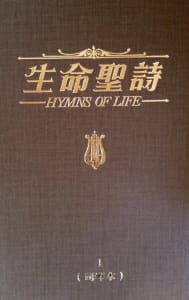
During my pastoral work more than 10 years ago, I occasionally tried to introduce the congregation to sing some of the retranslated hymns. Some brothers and sisters expressed that any alterations to the Hymns of Life, our denominational hymnal, were unacceptable, as if someone had damaged the Mona Lisa by adding a stroke to it. Some song leaders even stated that they would not lead singing if they had to sing newly translated lyrics (and I did not force them to sing the new lyrics). However, no single translation can be considered the only version on this planet, because it’s not original: it is simply a translation. I can understand that, since the brothers and sisters have long sung the Hymn of Life version as their only version, it will be very hard for them to sing any other version of it. The case is much like the introduction of newer Bible translations when people have memorized a typical version for a long time. So, the brothers and sisters’ inability to accept the re-translation is more based on subjective emotional factors than rational and objective analysis. Of course, it is also true that not every new translation is of equally high quality, but time will tell.
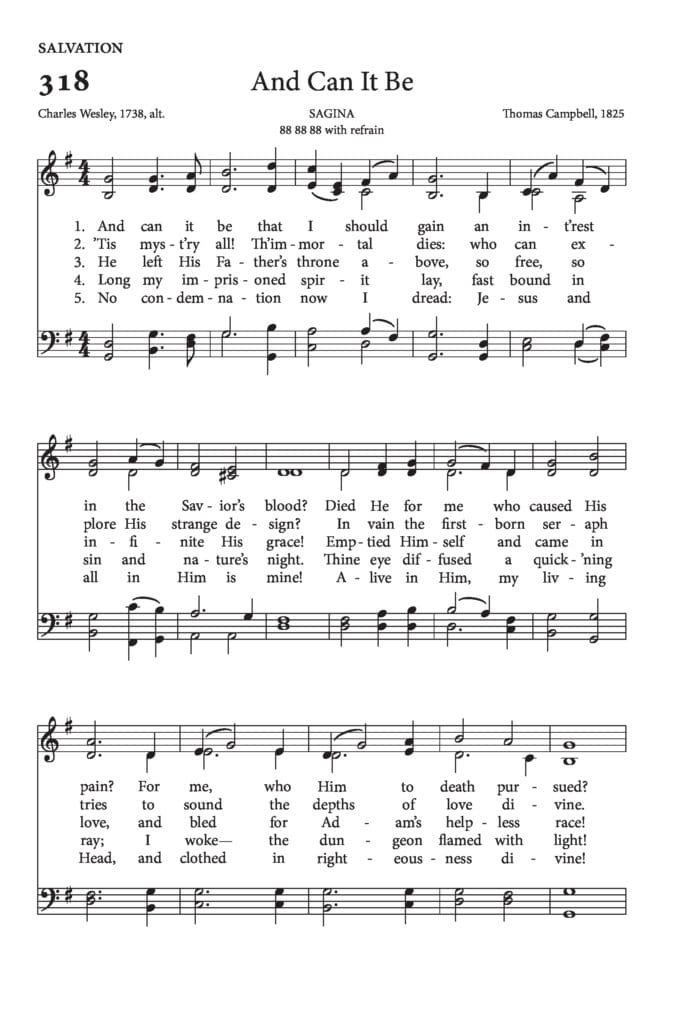
Original “And Can It Be” text and tune

In the past week, I encountered a rather serious problem when my church chose the retranslated version of “And Can It Be That I Should Gain” (lyrics by Charles Wesley, tune by Thomas Campbell) as our opening hymn.  The original version had multiple musical notes per syllable, but in Cantonese, with its tones, this is not the ideal way to express the lyrics. Therefore, the translator of this hymn decided to assign each character to a single note, much like how we handle Cantopops in our culture. While remaining faithful to the original lyrics, this approach does significantly differ from the original version in terms of singing. The organist suggested that the congregation should have some prior rehearsal of singing this hymn version, at least to let them know it was a different version. However, the pastor felt it was not necessary; the choir could sing the first verse once and the congregation would get it. As a result, most people were unable to sing the hymn.

Coincidentally, I was teaching Sunday school on topics relating to hymns and spiritual growth during this period at my church. After class, a student told me that she could not sing “And Can It Be That I Should Gain” at all during worship that day. She felt very frustrated and confused and asked me if there was something wrong with her. I replied that I understood this was a common experience for many people. The original hymn is so deeply ingrained in people’s minds that they have memorized it thoroughly. So, without any warning, a completely new version is introduced—not just different in the lyrics, but also in the singing style. In the phrase before the refrain, each musical note has a different Chinese character, which can indeed leave some people familiar with the original hymn feeling helpless. In particular, since the projection only shows the lyrics without any melody cues, people may wonder how they can sing the melody with so many words. It is truly difficult to master. Of course, I also told her why this version existed. I said that it was possible that in our community, when singing the old version before, the lack of harmonies meant the lyrics were not deeply understood or were even just parroted. However, because of this tone-fitting version, the lyrics could finally be heard by the singers, and our brothers and sisters could clearly and vividly hear the truths of imprisonment, the liberation from the chains, etc., and may therefore felt moved and grateful. This shows the diversity in our community. Because of mutual love and consideration for edifying others, even if we have a version we are already very familiar with, can we also wholeheartedly learn how to sing the new version, and even treating it as a new song to learn, so that the next time we have the opportunity to sing it, we will be more engaged and able to appreciate the communion, inclusion, and richness it brings?


Conclusion

Compared to our brothers and sisters in the English-speaking world, we do indeed encounter more complex situations when it comes to singing hymns. The church music pastors and leaders can surely help in this process by carefully attending to the congregation’s expectations and capacity, tailoring the needed preparation for specific hymns, and thoughtfully explaining the purpose of the new version to the congregation. This understanding and acceptance will reflect the beautiful sentiment of putting aside our own comfort zone and preferences for others, singing God’s glory in the most natural and meaningful way in the language God has given us. Even if it comes at a high price, it is worth it. May God receive the highest glory and praise because of what we sing and do!

In case you have missed my previous blogs on Cantonese Hymn Singing, you can find them here: Part I of V, and Part II of V, and Part III of V, and Part IV of V, and Part V of V.

 

Blogger Yvette Lau has bachelor degrees in Chinese and Translation, and Music, a Master in Worship, and a Doctor of Pastoral Music. She has served as one of the executive committee members of the Hong Kong Hymn Society from 2011-2017. Her passion lies in choral conducting, song writing, hymn translation from English to Cantonese (main translator for New Youth Hymns), event organization, translation of books on worship including The Art of Worship, Beyond the Worship Wars, The Worship Architect, and Glory to God, and training and teaching on worship.


 

The Context

Singer/Songwriter Paul Zach has released 1 EP in 2018 and has contributed to several of the albums already reviewed here on the blog, including The Porter’s Gate albums. Accordingly, he is no stranger to crafting songs for congregational singing. His newest release, Hymns, is simply that—fresh arrangements of time-tested melodies and lyrics. Zach has also cultivated the art of cowriting, as evidenced in the aforementioned Porter’s Gate albums, and Hymns includes many featured guest vocalists with whom Zach has written in the past. Familiar guests include Liz Vice, Leslie Jordan, and Page CXVI, with Taylor Leonhardt and The Sing Team rounding out the list.


The Content

Appropriate for the COVID season, this album sounds like it was recorded in an aged, empty church with wooden pews, with a few friends spaced out in the room playing and singing these hymns together. Rather than feeling empty or isolated, however, these songs immediately draw the listener into the intimacy of the recording, and even on my first listen I was drawn to sing along with the comforting melodies of the chosen hymns. Musically, Zach leans on acoustic instruments as the foundation for each song: acoustic guitar, piano, organ, and upright bass. This folk/americana style lends itself well to each hymn, and Zach harmonizes beautifully with each of his various guests. Although some of the starting keys that fit Zach’s tenor/baritone voice may be a bit high for general congregational use, these arrangements could easily be re-keyed without losing their intimacy and dynamics. Lyrically, Zach makes no changes to the original hymn texts and chooses not to add any new choruses or refrains to the arrangements. Rather, he uses verses of the hymns that often are omitted when such new elements are added to hymnody. The hymn choices span several generations, including the African-American spiritual “I Want Jesus to Walk with Me.” Other notable songs include: “Take My Life and Let it Be” (with its ebb and flow and soothing harmony), “Come Thou Fount” (including the swelling organ in the final verses), and “No Not One” (with its blues vibe and catchy bassline).


The Conclusion

This hymns album is a precious listening experience, and may remind some music directors and worship leaders of “old” songs that need a re-introduction in local churches. As Paul Zach makes clear, these songs have endured in part because it doesn’t take a full production team to sing them—an acoustic guitar and an earnest heart (and some talented friends to help) are all it takes to capture a fresh yet familiar take on rich and important hymns. This album comes highly recommended for those who need to rest in gospel truth or be reminded of songs that may be important to re-introduce during the reset that COVID quarantine has provided the local (and global) singing church.


To listen to the album, go to: Spotify Album – Hymns by Paul Zach


Review provided by David Calvert, who is the Creative Arts Director for Grace Community Church in rural North Carolina and a PhD graduate in Theology and Worship from Southeastern Baptist Theological Seminary.

Introduction

We know that planning worship during the global pandemic has not been easy. With all of the added stress, new skills (audio/video editing!!!), and constant curveballs, we know that you’re probably tired. With Easter just around the corner and plans being made, we hope that these accompaniment tracks will ease your burden a bit, giving you time and energy to focus on other projects and congregational needs on the horizon.

In total there are 15 hymns with the majority of those being recorded in two different styles. With the exception of the acapella selections (which necessitate vocals), these are provided without vocals so that you, your cantor, choir, or congregation can add their own voices to the track. Hymn suggestions are based on the Revised Common Lectionary readings.

All of these are public domain hymns, are free to download, and should be considered “creative commons,” meaning you can use them in any way you would like as long as credit is given to The Center for Congregational Song.


Downloads are available at the bottom of this page in our SoundCloud player, or by going to our SoundCloud account here.


Song List

1st Sunday – Feb 21st – A CAPPELLA SUNDAY

Jesus, Lover of My Soul [ABERYSTWYTH] – A Cappella with vocal percussion loops

My Hope is Built on Nothing Less [SOLID ROCK] – 1. A Cappella with soprano on melody  2. A Cappella with no melody


2nd Sunday – Feb 28th

Be Thou My Vision [SLANE] – 1. Piano & Violin    2. Full Band

The God of Abraham Praise [LEONI] – 1. Organ   2. Hard Rock

Fairest Lord Jesus, Lord of all creation [CRUSADERS’ HYMN] – 1. Organ  2. Band


3rd Sunday – March 7th

I Want Jesus to Walk with Me [WALK WITH ME] – 1. Simple Piano      2. Funk-Inspired


4th Sunday – March 14th

Of the Father’s Love Begotten [DIVINUM MYSTERIUM] – 1. Organ      2. Synth

Savior, Like a Shepherd Lead Us [BRADBURY] – 1. Piano & Flute       2. Wind Ensemble


5th Sunday – March 21st

Ah, holy Jesus, how hast thou offended [HERZLIEBSTER JESU] – 1. Organ     2. Guitar Ensemble

Come, Ye Sinners, Poor and Needy [RESTORATION] – 1. Funky Band


Palm/Passion Sunday – March 28th

All Glory, Laud and Honor [VALET WILL ICH DIR GEBEN] – 1. Organ & Brass        2. Hard Rock

What Wondrous Love Is This [WONDROUS LOVE] – 1. Synth & Violin

Praise, Praise, Praise the Lord (Cameroon) [LOUEZ LE SEIGNEUR] – 1. Percussion & “oo” Choir      2. Percussion Only

Sanna, Sannanina (South Africa) [SANNANINA] – 1. Percussion & “oo” Choir      2. Percussion Only

O Sacred Head Now Wounded [PASSION CHORALE] – 1. Organ & Cello     2. Strings


Playlist & Downloads

Download by clicking a track and then look for the “download” button on the top right hand corner of the soundcloud player. You can also go directly to our SoundCloud album here.


We weren’t going to post anything about Kanye West and his new album. Frankly, he gets enough press already and most of his music isn’t designed nor does it lend itself well to be considered “congregational.” But the latest news of him claiming to be the “greatest artist God has ever created” does open up an opportunity to explore that claim and learn about some church music history.

So here’s a list of 10 artists who Kanye obviously doesn’t know about that we think are worth mentioning when discussing the “greatest artist God has ever created.”

1. Theological Mastermind: Ambrose of Milan

Often called “The Father of Western Hymnody,” Saint Ambrose of Milan was a key figure in solidifying the idea that Christ was not a creation of God, but rather a full part of God from and of the beginning. Can many other artists in our history or today claim that they literally shaped and then defended a key tenant of the Christian faith? Check out one of his hymns we still sing today, “O Splendor of God’s Glory Bright.”

2. Composer & Theologian: Hildegard of Bingen

Given credit for founding scientific natural history in Germany, this 12th century nun is also one of the most well-known Pre-Reformation sacred composers. Just listen to this stunning performance of one of her chant arrangements.

3. Tune-Writer: Louis Bourgeois

You know the branch of Christianity called “Reformed” and “Presbyterian”? Well, the music that they sing was and is largely influenced by Louis Bourgeois who was largely responsible for the milestone “Genevan Psalter” in the 16th century. Most famously he’s credited with composing the tune OLD HUNDRETH, which is sung by countless congregations each and every Sunday. Here’s a great a cappella singing of the tune from a recent worship conference:

4. Composer & Theologian: J.S. Bach

It’s hard to find a composer who more carefully and skillfully combines music and theology than J.S. Bach. Organ, Orchestra, Voice…you name it. So many of his compositions are considered masterworks and are performed across the world each year by multiple ensembles that we don’t know where to begin. So here’s a playlist of the “best of Bach” for your listening pleasure.

5. Concertized Sacred Music: G.F. Handel

While much of Handel’s music is unremarkable when it comes to the “greatest” conversation, his oratorio Messiah has been continually sung/performed for over 270 years and counting. In 2014/2015, 13 of the 22 largest American orchestras performed the work 38 times. When people think church music, they think Messiah. Here’s a full performance:

Also, how can we mention Messiah and not also link to the “Soulful Celebration” remake from 1992?

6. Song Writer: Fanny Crosby

A blind woman living in the late 1800s, she wrote more than 8000 hymns and gospel songs and over 1000 secular poems. Her most popular hymn, “Blessed Assurance,” has appeared in over 900 hymnals and continues to be sung today. We were going to mention Charles Wesley, but we couldn’t leave out Ms. Crosby who wrote more hymns than he did!

Here’s another setting of Crosby’s hymn from the black gospel tradition:

7. Composer and Scholar: Harry T. Burleigh

The grandson of a partially blind ex-slave, Harry T. Burleigh did arguably more than anyone else in history to preserve and advance the music of Black Americans. For an introduction to his life and legacy, you can click here.

8. Secular/Sacred Crossover: Duke Ellington

One of the greatest and most influential jazz musicians, Sir Duke was not only a jazzer but a dedicated christian. His concerts of sacred music were a unique cross-over that paved the way for the church and the secular music industry to meet and influence each other.

9. Sacred Album: Aretha Franklin’s Amazing Grace

After her recent death, if you weren’t aware of the life and legacy of Aretha Franklin, you should be now. Her iconic album “Amazing Grace” was a game-changer for sacred music.

10. Contemporary Artist: Kirk Franklin

If you listen to Kanye’s new album and you’re familiar with the history of church music, and specifically black sacred music, you’ll hear a lot of influences in there. In fact, it’s hard to hear very much that is new at all. In particular, Kirk Franklin was paving the way for much of what you hear on Kanye’s album. If you’re not familiar with Franklin’s work, one of his most well known early albums is “Hero”:

Conclusion

Finally, this list is in no ways official or comprehensive. In fact, it’s very particular to a European and then white & black American history of church music. Other than Kirk Franklin we didn’t even mention any other music contemporaries like Marcos Witt of CanZion Productions whose music and educational ministries have reached Spanish-speaking Christians across the world with numbers in the millions (thanks for this tip, Adam Perez), or Shirley Erena Murray whose hymn texts are at the cutting edge of ecotheology, 21st century Christology that is in concert with scientific thought, and expressing non-western Christian worldviews. Our list is also hyper focused on music instead of art as a whole (remember the claim was on being the greatest “artist”). And, or course, there’s also the question of what the definition of a “great” Christian artist is, which most people would have to agree has to have different metrics than what the popular music industry gives us.

So, in short, no. Kanye is certainly not the “greatest artist God has ever created.” Seriously? Is there even such a thing? Probably not. We’re all made unique and are given a particular calling by God, not to mention there have been some seriously talented artists in the past and will continue to be in the future. Maybe a more accurate claim would be that Kanye is the greatest Prosperity Gospel Christian Rap/Hip-Hop Artist God has ever made who gave his life to Christ in the early 21st century. That’s probably true.


Author Brian Hehn is the director of The Center for Congregational Song.

Introduction

This episode is with English hymn writer and retired minister in the Church of England, Christopher Idle. It was recorded by Ben Brody at The Hymn Society in Great Britain and Ireland’s 2019 Annual Conference in Canterbury, England. For a full biography of our guest, click here.


Season 3 – Episode 4

In this interview with Christopher Idle who has written over 500 hymn texts, meaningful texts are shared from his faith story. Having been formed and served in the Anglican tradition, this interview explores what it like to be a hymn writer: struggles, discouragements, successes, and encouragements.


Listening time: 21 minutes

CLICK HERE TO SUBSCRIBE ON iTUNES

RSS Feed: https://anchor.fm/s/ef046998/podcast/rss

Also available on: iHeartRadio


Introduction

This episode is with professor of religious studies, hymn writer, and chair of the Presbyterian Committee on Congregational Song which produced Glory to God: The Presbyterian Hymnal, Dr. Mary Louise Bringle. It was recorded by Ben Brody at The Hymn Society’s 2019 Annual Conference in Dallas, TX. For a full biography of our guest, click here.

Season 3 – Episode 1

In this interview with Mary Louise Bringle, we get to hear about her faith journey, how she became a hymn writer, and so much more about how hymn-writing has shaped her life and how her life has shaped her hymn-writing.


Listening time: 42 minutes

CLICK HERE TO SUBSCRIBE ON iTUNES

RSS Feed: https://anchor.fm/s/ef046998/podcast/rss

Also available on: iHeartRadio


Blogger Brian Hehn is the Director of The Center for Congregational Song, adjunct professor of worship at Wingate University, and Director of Music at Light Street Presbyterian Church in Baltimore, MD.


This kind of information may be old news to some of our readers, but there are those of you who may not have grown up singing from a hymnal and have recently found yourselves being asked to either use or sing from a hymnal. I bet many of you might also teach Sunday School classes, confirmation classes, or other educational settings where a simple article on “how to use a hymnal” would be particularly useful to share. So here we go!


What is a hymnal?

If you google this question, you’ll read first that a hymnal is a noun with the definition of “a book of hymns.” But a hymnal is much more than that. For more in-depth answers to this question, I’m going to rely on two very thoughtful organizations. The first is The Hymn Society in Great Britain and Ireland, which is a sister organization to The Center for Congregational Song’s parent company, The Hymn Society in the U.S. and Canada. The Hymn Society in Great Britain and Ireland offers many “short guides,” one of which specifically answers the question what is a hymnal? The subheading they use with brief explanations following each are:

  • A good hymnal immerses us in Biblical language and the Biblical message.
  • A good hymnal is a handbook of theology.
  • A good hymnal is an important teaching tool.
  • A good hymnal is a key part of corporate worship.
  • A good hymnal is the voice of the church through history.
  • A good hymnal offers a broadly ecumenical meeting-place.
  • A good hymnal reminds us of the world-wide church to which we belong.
  • A good hymnal is a repository of the church’s diverse music styles.
  • And more…to read the full article, you can click here.

For another short but good read on what and why a hymnal is, check out this 1-page document from Samford’s “The Center for Worship and the Arts”: “Using-a-Hymnal”

Finally, if you’re in the “but aren’t hymnals going away” camp…or you have any friends or colleagues asking that question, here’s a wonderful article on the topic by John D. Witvliet of The Calvin Institute of Christian Worship.


What’s in a hymnal?

Hymnals generally have some, all, or more than the following sections:

  • Opening Liturgy/Worship Section – The beginnings of hymnals often include creeds, worship orders, prayers, and more. These are often denominationally specific, but often times these resources are broad enough to meet the needs of a variety of traditions and perspectives.
  • Hymns & Songs – This is, of course, the largest section of a hymnal. Hymns & songs are often organized by liturgical season (Advent, Christmas, etc…) and/or by theme (Confession, Adoration, Gathering, Sending, etc…).
  • Psalms – Sometimes psalms are included in the main part of the hymnal, but some hymnals have a special section for psalm settings. Sometimes this is near the beginning, in the middle, or at the end of the “Hymns & Songs” section mentioned before. Depending on the tradition a hymnal is from, these psalms may be musical settings, musical refrains with words for the verses, or just words that have “points” to enable chanting.
  • Copyright Index – Hymnals almost always include the bulk of the copyright information (and on the copyright holders) in an index in the back.
  • Topical and Scriptural Indices – Most hymnals will have both a topical and scriptural index. These are great for looking up hymns and songs that deal with specific topics (like a list of hymns that deal with “Comfort,” or if you’re trying to find a hymn that references a specific scripture (like a list of hymns that Luke chapter 2). The scriptural index is sometimes accompanied by a separate “lectionary” index that has hymn suggestions for all Sundays in the lectionary.
  • Other indices that are usually included are a list of authors, composers, and sources; tune names; Tune meters; and hymns alphabetically by first line.
  • For a wonderful explanation of how to use many of these common hymnal indices, check this article out: https://www.ashleydanyew.com/posts/how-to-use-the-metrical-index-in-your-hymnal


More Resources

If you have any questions about hymns or hymnals, there are two go-to places:

The first is The Hymn Society in the United States and Canada and the second is hymnary.org. These two organizations are the experts and have staff

that are more than willing to help answer your hymn and hymnal-related questions.


Here’s a fun video of how to use a hymnal (from a Lutheran pastor using a Lutheran hymnal…but generally useful information!).


We hope you’ll enjoy exploring your hymnal(s) and teach others about all they have to offer our communities of faith and our families.


Introduction

This episode is the 2nd part of Ben Brody’s interview with retired bishop and renowned hymn writer Timothy Dudley Smith.


Season 2 – Episode 5

In this interview with Timothy Dudley Smith we continue to hear about his story of faith and music-making in the church. His writing process, results, and impact are discussed.


Listening time: 24 minutes

CLICK HERE TO SUBSCRIBE ON iTUNES

RSS Feed: https://anchor.fm/s/ef046998/podcast/rss

Also available on: iHeartRadio


Introduction

This episode is with music professor and leading expert on Music of the African Diaspora, African American Culture, the Black Church, and Christian Worship, Dr. Emmett Price. It was recorded at the Calvin Institute of Christian Worship at their annual Worship Symposium.


Season 2 – Episode 4

In this interview with Dr. Emmett Price, we hear about his personal journey through song that informed his role as a pastor and now as a scholar focusing on the musics of the Black Church.


Listening time: 39 minutes

CLICK HERE TO SUBSCRIBE ON iTUNES

RSS Feed: https://anchor.fm/s/ef046998/podcast/rss

Also available on: iHeartRadio


Introduction

This episode is with Dr. Lisa Weaver and Dr. James Abbington. It was recorded by Ben Brody at the Calvin Institute of Christian Worship during their annual Worship Symposium in January 2019.


Season 2 – Episode 1

In this interview with two of the most influential scholars and leaders in church music, Ben Brody asks about the creation of the newest GIA African American hymnal “One Lord, One Faith, One Baptism,” what hymns have influenced these guests the most in their lives, and how certain hymns and songs become favorites of individuals as well as larger denominations.


Listening time: 36 minutes

CLICK HERE TO SUBSCRIBE ON iTUNES

RSS Feed: https://anchor.fm/s/ef046998/podcast/rss

Also available on: iHeartRadio