

This post is re-posted by permission of both the author and its original platform The Christian Century. To read the original post from November 2025 by Melissa Florer-Bixler, you can click here.
My colleague’s Black church was taking a break from anti-racism work with White churches. So we decided to sing together.
A Book, A Grant, and A Challenge
A few years ago, I came across a book called Worship Across the Racial Divide. Its chapter titles were arresting: “African Americans as the Icon of ‘True Worship,’” “The Naïve Experience of Worship in Multiracial Churches,” “‘Have You Seen Our Gospel Choir?’ Conspicuous Color in Multiracial Worship.”
The book’s author, sociologist Gerardo Martí, spent two years studying 12 racially integrated congregations in Southern California. The most common feature he found in these churches was a Black music leader or gospel choir, meant to attract those outside the White majority. While this model does foster cross-racial relationships within a music program, Martí found that it also reinforces stereotypes that essentialize race. Universally, his interviewees considered Black worshipers’ experience to be more authentic than anyone else’s. In addition, Black religious life influenced the music of the service but nothing else—not attire, service length, preaching style, or nonmusical leadership.
I read Martí’s book with trepidation. Our majority-White congregation was about to spend a year exploring anti-racist worship practices, thanks to a grant from the Calvin Institute of Christian Worship. For decades, our church had invested in anti-racist education, social action, and relationship building. We had not investigated our worship practice. How could we worship in a way that bore witness to God’s transforming, barrier-breaking reign? What did we need to consider anew? After reading the book I probed other questions alongside these. Did the use of Black church music offer hope for a new world, or did it reinforce racism? What was at the root of the desire to foster a racially diverse church?
The Year Exploring Anti-Racist Worship Practices Begins
That year we interviewed and worshiped with intentionally multiracial churches whose pastors were people of color. We studied together. We tried new practices in worship. We partnered with one church to cohost vacation Bible school. But our primary relationship was with St. Ambrose Episcopal Church, a historically Black church in a historically Black part of our city.
I remember meeting with Jemonde Taylor, the church’s rector, to propose the idea of a partnership. He explained that after working with majority-White churches, his congregation experienced “yoke fatigue.” The churches that approached St. Ambrose for partnership were filled with well-meaning White people who wanted to undo their racism and find ways to be better allies. This most often took the form of study groups in which the Black church partner was the expert. St. Ambrose was intentionally taking time off from this demanding and emotionally exhausting endeavor.
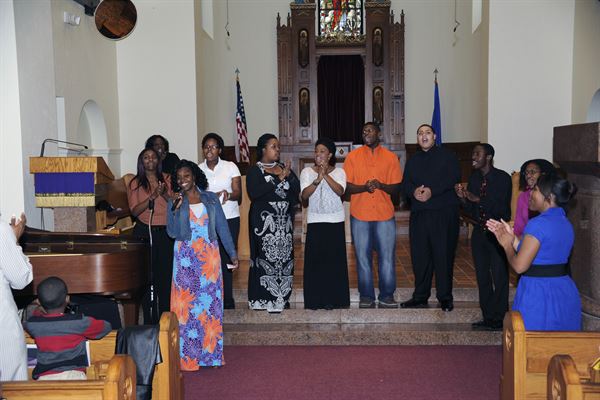
I suggested something else. We would entrust our learning to experts who were compensated for their labor. Instead, we would sing together. I told him that our worship committee was suggesting a joint choir during Lent. Each week we would join St. Ambrose for choir practice, where we would learn songs significant to the life of their church. At the end, we would share a worship service together.
Then he made an additional suggestion. Perhaps St. Ambrose could learn something from our church, too. He shared about their interest in exploring music that breaks the norm of masculine language for God. Could we introduce music that offers more expansive imagery?
We agreed to the undertaking. We would exchange gifts: one week Raleigh Mennonite would teach a song to the St. Ambrose choir, and the next we would learn a song that was central to St. Ambrose’s worship. On Sundays, in our separate worship services, each choir would introduce the congregation to the new song we learned.
Reflections on the Year
During this time, I thought about Martí’s finding that churches become multiracial through the auspicious incorporation of Black church music that disconnects it from its roots in liberation from enslavement and the long, slow march to freedom. They recontexualize it in a way that is not devoid of meaning but does produce a different kind of music. Martí helped me understand what might happen when a majority-White church incorporates music from cultures and experiences beyond its own.
Instead of rejecting this practice as inherently exoticizing, I began to see our church’s incorporation of music from other cultures as holding us within a web of relationality and responsibility. We weren’t involved in a translation project, trying to map a different experience onto our own. Sharing music gave us a new language of praise, one that emanated from a previously established form of life.
Years before I approached Taylor about a shared choir, he had called me about the impending rezoning of a massive piece of property abutting his church’s neighborhood. The $2 billion development would skyrocket property taxes in the community, forcing Black homeowners to sell. And the increased sewage outflow would cause catastrophic flooding in buildings downstream, including the church and its neighbors. The next months were a blur of calls with city councilors, working to line people up for a press conference, and strategizing with a local environmental justice group. We worked together to secure a guarantee to address issues of water runoff.
Through a shared commitment to the other’s flourishing, by showing up when our siblings in Christ were in trouble, we developed a new context and meaning for the songs our churches sang together. Later, whenever our choir sang one of the shared anthems, I would think, This is a St. Ambrose song. I remembered those songs as a gift that announced the redemption of all things.
 Melissa Florer-Bixler is a doctoral student in homiletics at Duke Divinity School and the author of How to Have an Enemy and Fire by Night.
Copyright © 2025 by the Christian Century. “Shared songs with new meaning” by Melissa Florer-Bixler is reprinted by permission from the November 2025, issue of the Christian Century. christiancentury.org
 If I were to purchase a simple liturgical music library for you…a “small-church music starter kit,” here’s what I would send you:
 Small choir resources are tough, especially when people are still working off the old model of “we used to be…”. I think this is where placing the congregation’s voice as #1 is really helpful. It changes the choir’s “job” from singing a solo anthem every week to supporting the congregation’s music-making. I think we do a disservice to ourselves, our choir members, and our congregation to expect a small volunteer group of singers to sing a published anthem every week with enough musicality and precision that it truly edifies the congregation and singers. But, if we re-frame the choir’s role as supporting the congregation, here’s what can happen:
 job that involves working at the school affiliated with my church. I have to say, I’d forgotten how much having children around makes each holiday feel so special. Children have an enthusiasm for celebrations and traditions that is infectious to the rest of us. Easter Sunday may not be a good time for the children’s choir to sing, but it’s perfectly appropriate to have them sing an Easter song on the Sunday(s) after Easter. Small children delight in having songs to sing that go with whatever season it is, so even if you’re working with children in a less formal setting than a choir, you can keep singing your resurrection songs all through the season. (Sidebar: I’ve found there aren’t enough Easter songs to satisfy the appetites of young children. Which Easter songs do your children love?) You might find that you have more opportunity to discuss the true meaning of Easter with the children once the Easter bunny has faded away, too.