


The original version of this article first appeared in Leader magazine, Spring, 2026, copyright © MennoMedia. All rights reserved. Used by permission.
When I was taking a music course as an undergraduate student, I learned about the Singing Revolution in Estonia. My professor explained that singing was one of the ways that Estonians protested Soviet occupation in the late 1980s and early 1990s, bringing together thousands of people in a nonviolent demonstration of their desire for political freedom. I remember how it offered such a hopeful image of music standing in the place of conflict. Music is a force for peacemaking.
We are also well aware of music’s capacity to hurt people—including ourselves. Here are a few of my own shortcomings:
- I have made countless mistakes while serving as a piano accompanist or song leader in church services, causing the congregation to falter and disrupting their worship.
- I have tokenized and culturally appropriated other people’s music.
- I have engaged with music that exists within industries built on exploiting some people while elevating the status of others.
- I am probably guilty of singing along when music has fostered division instead of making peace between opposing groups.
In my own life and in the wider world, music sometimes breeds conflict or fosters division instead of making peace. It polarizes communities and perpetuates violence. It is a pervasive source of potential harm.
Music is often a starting point or a sustaining energy rather than the celebrated final step.
At the same time, music is not usually life-threatening. (As another one of my professors once told me, “It’s just music. No one’s gonna die.”) I was reflecting on this point several months ago when I received an email from members of Mennonite Action informing me that a group of Mennonites were arrested in Washington, DC because they were singing and bearing signs in support of bringing lasting peace to Gaza. I affirm their work and witness, but I was surprised by the triumphant tone of the email, since the situation was not particularly dangerous and did not result in any concrete support for Gaza from the DC authorities. Again, music is not usually life-threatening, and its power is sometimes limited. I want to caution against music as a virtue signal and instead frame it as one of many important ways of making peace in the world. Music is often a starting point or a sustaining energy rather than the celebrated final step.
When we see music as a powerful force, but rarely a life-threatening one, it becomes a place where we can be brave enough to try encountering each other as broken and beloved children of God. It is a fallible but foundational site of peacemaking that envelops us as we falter, learn, and grow.
For instance, as part of leading worship at Mennonite Church Canada’s national gathering in July, I was tasked with selecting music to reflect our increasingly intercultural identity. As I explain in another blog, it felt like a risky endeavour with huge potential to harm and/or offend people representing both dominant and non-dominant cultures. It helped to remember that music would not be life-threatening in this case. Releasing our own musical expectations to encounter the music of someone else does not put our entire identity at risk. Rather, it helps us to see from a new angle that we are all broken and beloved children of God, each with our own intricacies expressed through music.
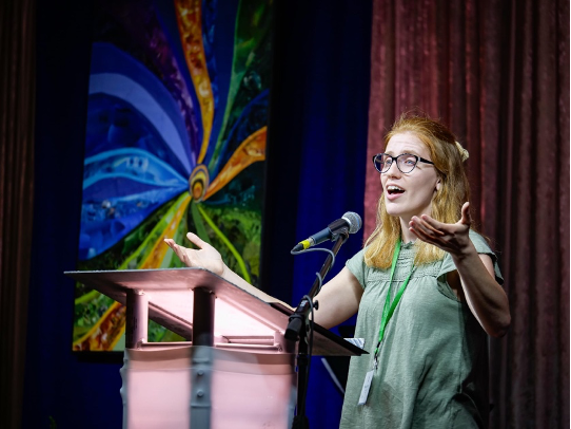
Leading worship at Mennonite Church Canada’s national gathering in July 2025. Photo taken by Ruth Bergen Braun.
A second example comes from my experience of directing Ontario Mennonite Music Camp for the first time in 2023. I can still recall 25 high school students passionately singing these words at our final concert:
“I will not hate, and I will not fear. In our darkest hour, hope lingers here.” They were not putting themselves at risk by singing these words to an audience of parents and devoted community members, but it nevertheless brought tears to my eyes because, again, music is often a starting point or a sustaining energy rather than the celebrated final step. The song laid a foundation, setting the students on the risky (but abundantly worthwhile) path of recognizing all people as broken and beloved children of God.
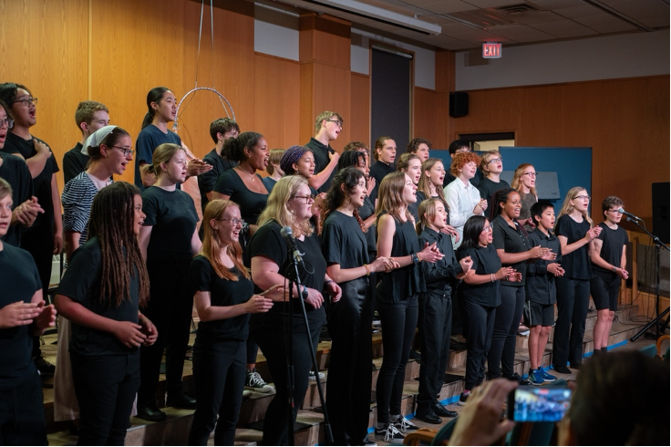
Ontario Mennonite Music Camp participants singing at their final concert in 2023. Photo taken by Margaret Gissing. To learn more, visit https://uwaterloo.ca/grebel/ontario-mennonite-music-camp.
These two anecdotes are not earth-shattering. Neither of them comes close to the description of the peaceable kingdom extending throughout the whole earth in Isaiah 11:6–9 (CEB):
6 The wolf will live with the lamb,
and the leopard will lie down with the young goat;
the calf and the young lion will feed together,
and a little child will lead them.
7 The cow and the bear will graze.
Their young will lie down together,
and a lion will eat straw like an ox.
8 A nursing child will play over the snake’s hole;
toddlers will reach right over the serpent’s den.
9 They won’t harm or destroy anywhere on my holy mountain.
The earth will surely be filled with the knowledge of the Lord,
just as the water covers the sea.
We’re not there yet, but I trust that we’re on our way. At least in my experience, when we embrace music as a place of encounter, a fallible but foundational site of peacemaking, we open ourselves to the wisdom of the Spirit, and, slowly but surely, the peaceable kingdom draws nearer.
 Mykayla Turner holds a Master of Sacred Music with a Liturgical Musicology concentration and a Master of Theological Studies. She obtained her A.C.C.M. in Piano Performance from Conservatory Canada. Currently, she is a PhD student in the Faculty of Theology at Saint Paul University in Ottawa, ON. Apart from her academic work, she is an active church musician and liturgist. She also co-directs Ontario Mennonite Music Camp and chairs the team of volunteers who maintain Together in Worship, a curated collection of free worship resources from Anabaptist sources.