

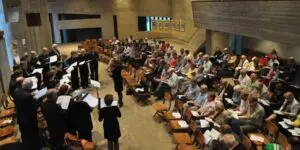
I was thrilled to be invited by THS sister organization IAH (the International Society of Hymnological Studies) to their biannual conference in Strasbourg this year (Aug 31-Sept 4) as one of their keynote speakers. The theme of the conference was “Written Sources – Digital Possibilities – New Perspectives.” It was an incredible opportunity to share my work on decolonizing congregational singing with an entirely different crowd. I was also grateful for the chance to learn from European colleagues about their work on Hymnology in various contexts and especially in the Alsace region in which Strasbourg is situated, one of the heartlands of the European Reformation(s).
Rooted in History and Context
With great care, the conference host Dr. Beat Föllmi, Professor of Sacred Music and Hymnology for the Faculty of Protestant Theology at the University of Strasbourg, welcomed conference participants and introduced us to the fascinating world of 16th century reforming movements in the city. Unlike other locales, congregational singing found a home in Strasbourg particularly at St. Thomas Church (Thomaskirche) where Martin Bucer was for several years. The church is also home to an organ that was once played by Mozart while he was there for 2-3 months. We were also treated to an exhibit of early psalters from various reform traditions including an early Huguenot volume. The portrait of hymn singing in 16th century Strasbourg was filled out with a lecture Cambridge University Professor Dr. Daniel Trocmé-Latter.
Our second morning (Wednesday) included a practical presentation about various digital hymn resources by Phil Price including hymnquest.com (UK based), hymnary.org, and the Canterbury Dictionary of Hymnology (hymnology.hymnsam.co.uk) among others, along with a presentation on scholarly hymn databases in German by Beat Föllmi and Christiane Schäfer. The conference wrapped up on the Friday with a panel discussion of the merits of digital hymn resources. It was fascinating to hear about the challenges facing Christian communities throughout Europe with respect to digitizing, including issues like access (to resources and connectivity) as well as the impacts on worship and community, among many others.
We enjoyed eating fabulous local food together and worshipping together in historic churches like St. Thomas, Temple Neuf, the Church of the Dominicans, as well as in a modern Roman Catholic Church on the university campus (Église du Christ Ressuscité).
Windows to the World
On Thursday morning, it was my turn. I shared the time with Cameroonian scholar Jacque Hippolyte Tayo who traced the history of congregational singing in the Lutheran Church of Cameroon, demonstrating its Indigenisation through the years. Through choral groups, the singing of local communities has been encouraged and supported in many of the local languages.
I was quite nervous! My work proposes a very rooted contextual approach to scholarship that requires naming who we are as scholars and where we find ourselves. I wondered how that would go over among European scholars who tend to take a more empirical approach that does not name social location as a matter of course. I was also very aware of the critical edge of my proposal, albeit for my own Canadian context (not too different from many USA contexts). I advocate a three-pronged approach to decolonizing congregational singing that includes:
- Interrogating our traditions
- Paying attention to what communities sing (even when it seems colonial) including the way they “flip” colonial hymnody to make meaning in their own contexts, and
- Affirming congregational singing from the Global South and marginalized contexts in the Global North.
In my presentation, I also explored the question of how the birth of the various Reformation movements and their liturgies, beginning with Luther, Cranmer, and Calvin, might be intertwined with the European colonial project which began at the same time, noting along the way that Roman Catholic liturgical practices which spread through Latin America and in what was to become French speaking Canada also need to be scrutinized. I asked: How much do the very practices treasured as quintessentially part of our traditions potentially reflect and embody this historic reality, expressing the colonial aspirations of the day or are infected with an incipient colonial mindset? Basically, my work is pretty provocative.
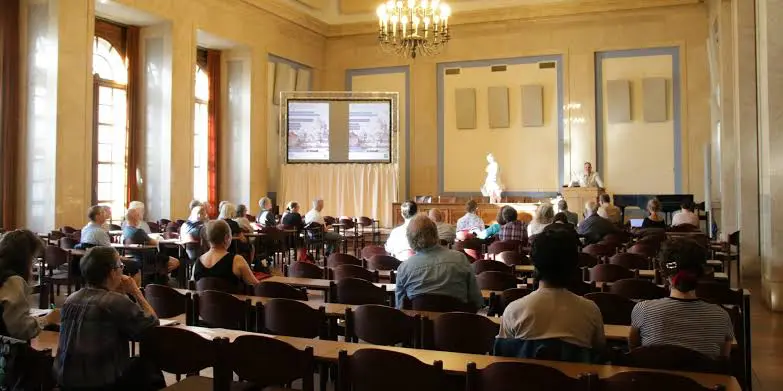 To my delight, the lecture was very well received. I was especially surprised at how conference participants made connections with what was happening in the early days of the Reformation(s) inside Europe. For instance, several reforming movements were persecuted as Lutheranism or Calvinism took hold, like the Anabaptists or the Huguenots. One participant pointed out that the imposition of one version of German contributed to the (almost) erasure of local languages in the Alsace region. Many also saw the connection between decolonizing hymnody and their own work on editing denominational hymnals in Europe.
The next conference will be in Graz, Austria in 2028 and I know they will make members of THS welcome!
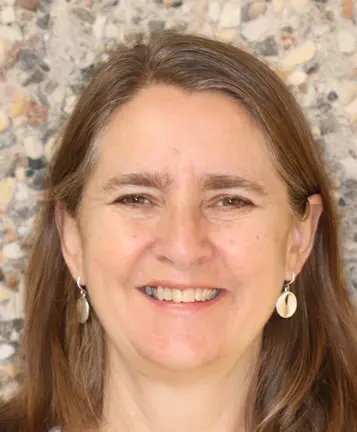
Becca Whitla is the Professor of Practical Ministry and the Dr. Lydia E. Gruchy Chair in Pastoral Theology at St. Andrew’s College in the Saskatoon Theological Union in Saskatoon, Saskatchewan where she teaches worship and liturgy, preaching, religious education, and practical theology. She has more than 20 years of experience animating liturgy and community singing in multiple contexts. Through her work she aims to foster transformative leadership. In her teaching and scholarship she focuses on how liturgy, community singing, ministry, and community activism can embody a liberating praxis that nourishes and affirms fuller expressions of complex cultural identities. She celebrates and fosters diverse multicultural, multilingual, and multi-ethnic communities. She believes in equipping churches and church leaders to model and shape diversity and inclusion in our present social climate.