

“One generation shall extol your works to another
and shall declare your mighty acts.”
—Psalm 145:4 (NRSVUE)
Have you ever walked into a large cathedral and noticed organ pipes at the front—and then turned around and discovered another set of pipes at the back? That second organ is called an antiphonal organ. Because it is separated from the main organ, the two sections can create an echo, with music seeming to answer back and forth across the sanctuary.
Eugene Peterson uses this same image when reflecting on Psalm 145:4 and the worship of God’s people:
“Praise is antiphonal between the generations. Praises lifted in one century are echoed in another. Our voices pick up themes announced hundreds of years ago and add personal variations, producing ‘the voice of a great multitude, like the sound of many waters and like the sound of mighty thunderpeals, crying out, “Hallelujah!”’”
—Eugene Peterson, Praying with the Psalms © 1993
What a beautiful picture of the church.
When we sing together, we are doing more than singing words printed on a page. We are joining a song that began long before us and will continue long after us. Think about the generations represented in our congregation. A child may hear a grandparent singing a hymn that has been part of the church’s worship for decades. A young person may sing words that Christians have been singing for centuries. And when older members hear the voices of children and young adults, they are reminded that the faith continues.
How might we be more intentional in worship about creating this antiphonal dialogue between the generations?
This fall, our church began a year of reading the entire Bible together as a congregation called “One Story. One Church. One Year.” As we launched this focus on Rally Day, we chose hymns with this idea of generations in mind. Before the sermon, we sang Philip P. Bliss’s beloved hymn “Wonderful Words of Life,” a heart song for many members of the older generation:
Sing them over again to me,
wonderful words of life;
let me more of their beauty see,
wonderful words of life.
We also introduced the congregation to a newer hymn, “God of the Bible (Fresh as the Morning),” with lyrics by Shirley Erena Murray and music by Tony Alonso. The choir sang the verses while the congregation joined in the refrain. Our choir includes many college-aged voices, so as we sang, we could actually see different generations participating in the music together.
God of the Bible,
God in the Gospel,
hope seen in Jesus,
hope yet to come,
you are our center,
daylight or darkness,
freedom or prison,
you are our home.
Marty Haugen’s “God Is Still Speaking” was also sung by the choir, with a cantor leading the call-and-response. Its words remind us that God continues to speak, offering hope, strength, and the promise of renewal:
Open up your ears to hear: God is still speaking
Living Good News, strong and clear: listen and draw near.
Through the struggle, grief and pain: God is still speaking.
God can raise us up again: listen and draw near.
As I listened to the music that day, I found myself thinking again about the antiphonal organ. One generation sings, and another answers. The older generation says, “This is the faith that has carried us.” The younger generation responds, “We have heard you, and we will carry it forward.”
Like an antiphonal organ, the sound moves through the sanctuary—front to back, young to old, one generation to another. The music becomes a conversation between generations. We are not simply singing with one another. We are singing the faith to one another.
Someday, our voices will be the ones another generation hears. Together, we are adding our voices to “the voice of a great multitude.” And the song continues.
Hallelujah!
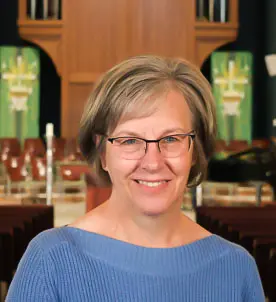 Blogger Denise Makinson has served as Director of Music Ministries at Southwood Lutheran Church (ELCA) in Lincoln, Nebraska, since 1994. Over the years, she has had the joy of exploring the many ways music can enrich worship, tell the Christian story, and bring people together. At Southwood, she has helped nurture a music ministry that embraces a wide variety of musical styles and traditions, always with the hope that music will help people encounter God and experience the Gospel more deeply.