

interior top image

Antiphonal Praise


“One generation shall extol your works to another
and shall declare your mighty acts.”
—Psalm 145:4 (NRSVUE)

Have you ever walked into a large cathedral and noticed organ pipes at the front—and then turned around and discovered another set of pipes at the back? That second organ is called an antiphonal organ. Because it is separated from the main organ, the two sections can create an echo, with music seeming to answer back and forth across the sanctuary.

Eugene Peterson uses this same image when reflecting on Psalm 145:4 and the worship of God’s people:

“Praise is antiphonal between the generations. Praises lifted in one century are echoed in another. Our voices pick up themes announced hundreds of years ago and add personal variations, producing ‘the voice of a great multitude, like the sound of many waters and like the sound of mighty thunderpeals, crying out, “Hallelujah!”’”
—Eugene Peterson, Praying with the Psalms © 1993

What a beautiful picture of the church.

When we sing together, we are doing more than singing words printed on a page. We are joining a song that began long before us and will continue long after us. Think about the generations represented in our congregation. A child may hear a grandparent singing a hymn that has been part of the church’s worship for decades. A young person may sing words that Christians have been singing for centuries. And when older members hear the voices of children and young adults, they are reminded that the faith continues.

How might we be more intentional in worship about creating this antiphonal dialogue between the generations?

This fall, our church began a year of reading the entire Bible together as a congregation called “One Story. One Church. One Year.” As we launched this focus on Rally Day, we chose hymns with this idea of generations in mind. Before the sermon, we sang Philip P. Bliss’s beloved hymn “Wonderful Words of Life,” a heart song for many members of the older generation:

Sing them over again to me,
wonderful words of life;
let me more of their beauty see,
wonderful words of life.


We also introduced the congregation to a newer hymn, “God of the Bible (Fresh as the Morning),” with lyrics by Shirley Erena Murray and music by Tony Alonso. The choir sang the verses while the congregation joined in the refrain. Our choir includes many college-aged voices, so as we sang, we could actually see different generations participating in the music together.

God of the Bible,
God in the Gospel,
hope seen in Jesus,
hope yet to come,
you are our center,
daylight or darkness,
freedom or prison,
you are our home.

Marty Haugen’s “God Is Still Speaking” was also sung by the choir, with a cantor leading the call-and-response. Its words remind us that God continues to speak, offering hope, strength, and the promise of renewal:

Open up your ears to hear: God is still speaking
Living Good News, strong and clear: listen and draw near.
Through the struggle, grief and pain: God is still speaking.
God can raise us up again: listen and draw near.

As I listened to the music that day, I found myself thinking again about the antiphonal organ. One generation sings, and another answers. The older generation says, “This is the faith that has carried us.” The younger generation responds, “We have heard you, and we will carry it forward.”

Like an antiphonal organ, the sound moves through the sanctuary—front to back, young to old, one generation to another. The music becomes a conversation between generations. We are not simply singing with one another. We are singing the faith to one another.

Someday, our voices will be the ones another generation hears. Together, we are adding our voices to “the voice of a great multitude.” And the song continues.

Hallelujah!
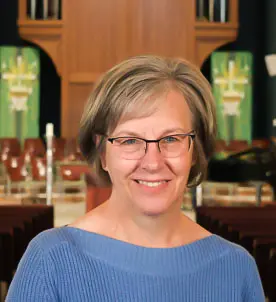


Blogger Denise Makinson has served as Director of Music Ministries at Southwood Lutheran Church (ELCA) in Lincoln, Nebraska, since 1994. Over the years, she has had the joy of exploring the many ways music can enrich worship, tell the Christian story, and bring people together. At Southwood, she has helped nurture a music ministry that embraces a wide variety of musical styles and traditions, always with the hope that music will help people encounter God and experience the Gospel more deeply.

Author – Brian Hehn is the Director of The Center for Congregational Song and not an expert in silence…but here we go!


Silence

How much silence is incorporated into your weekly worship services? In a world defined by continuous sound we are increasingly deprived of silence, and questions are arising about the spiritual implications this has on Christians today. A few years ago, I was serving a United Methodist Congregation in North Dallas and was bothered by the lack of intentional silence we incorporated. If there was silence, it was usually a mistake or was considered awkward by both the leadership and congregation. In a service with no silence, where is the opportunity for us to listen to God together? Where is the opportunity for people to explore their innermost confessions and desires with God without being told what to think, pray, sing, or do?


A Crazy Idea

So I had a crazy idea. You know that piece that all music majors learn about by John Cage? Yeah, the one that is all rests. It’s called 4’33” because the piece is designed to last 4’33” and calls for the performers to not intentionally play any musical sounds. Of course, Cage had many reasons for writing such a ridiculous piece of what most people would consider not music. There are many hilarious articles and reactions to the piece, which you can read about here. Ok, so you know that piece? We’re going to do it as a congregational song.

But what would the pastor say? What would the congregation do? Would there be riots…laughter?


Step One

I had to pitch the idea to the pastor. It’s unwise to do risky liturgical ideas without full support from the staff and your boss. He was skeptical of the idea, but I had spent two years with Pastor Jack and he knew he could trust me and that the congregation trusted me. So he ok’d the idea.

What would God do? I had no idea.

Step Two

I had to place the song in the liturgy. In our service, we incorporated a time of confession near the beginning of the service. Sometimes that time was a confession as in “I believe,” and sometimes it was used as a confession as in “I confess.” That time was followed by the scripture readings for the day. This seemed like the perfect time, but we needed a transition into the scripture readings…something to mark the end of the 4’33”. I came across a choral anthem which was a setting of “Come and Find the Quiet Center” by Shirley Murray. Even better, the last stanza had an opportunity for the congregation to join in. To see that anthem, you can click here.


Step Three

I had to prepare the choir. Don’t underestimate this step when doing something “out-of-the-box” at your church. Your choir can be your best advocate. Use some rehearsal time to explain to them what’s going to happen and why it’s going to happen. Let them ask questions and have reactions. Use that time to teach and encourage them to have equally open conversations with congregation members when they leave church that day. Empower them to help education and shepherd the congregation. Not only does this encourage their own ministry in music, it also helps keep your job secure!


Step Four

I had to figure out how to lead the song. I decided that the best way to lead the song would be to display the score on our screen, give a downbeat to the congregation, start the timer, and sit down. At the stroke of 4’33”, I would give the downbeat to the pianist which would cue the choir to stand. No explanations needed…in fact, I think if I explained it, then it would have killed the moment.


Last Step

Do it! Was I nervous? Yes. Was I excited? Yes. What would happen? What would the people do? What would God do? I had no idea. So I lead the song as planned. The score came up on the screen. I gave a downbeat, started my stopwatch, and sat down.

Minute 1 – shuffling, at least 3 giggles and 1 outright laugh.

Minute 2 – almost total silence with still a bit of shuffling.

Minute 3 – total quiet. The air conditioning starts up. A car honks its horn in the intersection nearby.

Minute 4 – total quiet….ambient noise continues.

Anthem begins – The choir begins its anthem, and I could hear the shuffling of feet and bodies in the pews. I turned around for the last stanza (melody & words in the bulletin) and invited the congregation into the song…

“In the Spirit let us travel,

open to each other’s pain,

let our loves and fears unravel,

celebrate the space we gain:

there’s a place for deepest dreaming,

there’s a time for heart to care,

in the Spirit’s lively scheming

there is always room to spare!”

– Shirley Erena Murray, Copyright 1992 Hope Publishing Used by Permission


Reaction

So what was the result? What did people experience? How did they react?

A few people didn’t like it, and they told me that it was “weird” or that they “didn’t understand why we would waste 4 minutes just sitting.” And a few people were weeping. They wept for reasons that I will never know. One first-time visitor to the church told Pastor Jack after the service that, “although she didn’t know it, the hymn of silence was exactly what I needed. Thank you.”


For other blogs from The Center for Congregational Song, go to: https://congregationalsong.org/conversations/blog-connections/