

Author – Ginny Chilton Maxwell is Music Minister at Church of the Ascension in Norfolk, Virginia, where she serves as organist, choirmaster, and elementary music teacher.
I’ve been thinking a lot about failure lately. At work I lament that I flubbed my postlude or that a new hymn went over like a lead balloon. At home sometimes I can’t seem to comfort the baby, and my dining room floor is covered in about a quarter inch of Cheerio dust. So I was energized to read the latest newsletter from the Center for Congregational Song, which talks about “success” and what that means to us who serve Christ. “So ultimately,” it says, “the answer to ‘how will we know we’ve been successful?’ is that we’re not 100% successful until God’s kingdom comes. Until then, we work and we sing!” Yes, Amen! This message came at a perfect time in my life. In this blog post are some ways my work in congregational song has taught me to celebrate failure as a necessary and even healthy part of that work. Maybe you’ll see yourself in some of my reflections and be able to share your experiences below.
I start to wonder if this decline is a reflection on me; if I was a flashier performer or a more charismatic leader, would things be better?
Failures piling up…
Perhaps the thing that has been most persuasive concerning the power of failure is that I now basically work full time with very small children. Children under five are extremely active. I now pack more in before 9 am than I used to in a whole day! So, there are plenty of opportunities for failure. How many songs have I tried to teach them that never caught on? How many music classes went by where I struggled to keep my students focused? As I began reflecting, I realized that I was keeping better track of my failures than my successes. Though it feels like my failures are piling up, it is actually because of them that I’ve become a better musician, a better curator of songs, and a better teacher. I am where I am today because I have failed so many times!
I found myself in that moment giving thanks to God for my failure. I was reminded of one of my favorite passages in Second Corinthians, where Paul tries to explain to his readers what it means to boast in Christ: “That is why, for Christ’s sake, I delight in weaknesses…. For when I am weak, then I am strong.” 2 Corinthians 12:10. I’ve always liked this passage because Paul isn’t just saying, “It’s okay to be weak,” or “Be weak if you have to.” He’s really rejoicing in weakness! When I fail I am reminded to rely more fully on God’s grace, and I realize how much I need God and the support of other people. It is humbling and strengthening. It also gives me a chance to learn from my mistakes–if I’m not making mistakes, I’m probably not being bold enough each day.
“It used to be so much better than it is now…”
Failing to teach a song or manage a classroom of children is one kind of failure, but working in a declining church feels like another thing entirely. I know there are people reading this blog who work or worship in a mainline Protestant church, or another church that is experiencing decline. It can be deflating to worship with too few people in your sanctuary, to not see many young people darken your door or have many new members join your choir. I know I start to feel worn down when I have to constantly listen to parishioners talk about how much better things used to be. I start to wonder if this decline is a reflection on me; if I was a flashier performer or a more charismatic leader, would things be better?
I’m thankful for places like the Center for Congregational Song that remind me to put things in perspective: I didn’t decide to serve the church in order to make myself look good or to amass successes. I became a music minister because I want to serve Christ who came to earth because he was so crazy in love with each and every one of us. God calls us to emulate Jesus, whose entire life was lived out only for others, never for himself. As leaders and participants in congregational song, we work and we sing and we leave the rest to God. I’m reminded of another favorite Bible passage, Psalm 127: “Unless the Lord builds the house, the builders labor in vain.” Prosperity and adversity will come and go, successes and failures will come and go; God remains God, and our call to serve God will be the same in every circumstance. Amen!
Sin(g) Boldly!
I was highly entertained by reading the blog post from May 16th, “A Profound Silence,” in which Brian Hehn describes performing John Cage’s 4’33” in his church’s worship service. Brian tells the story from when he first got the idea through the performance and the feedback, which was mixed: some snark, some gratitude. I appreciate that Brian blogged about something with such a real life outcome in a culture that tends to only want to publish filtered and polished success stories. This wasn’t a conventional success story, but I think it was still successful. It sounds like the Spirit spoke to Brian, he acted on it, and now he’s learned something from what did and didn’t go well. As I embrace failure and read stories like this, I’m reminded to sin(g) boldly and to act more on the Spirit’s leadership than on fear. I’m also reminded to focus more on building God’s Kingdom than on tallying my successes at the end of the day. Finally, I’m thankful to have a tribe like the folks I know through the Center for Congregational Song to remind me why I do this work. We work and we sing!

For more blogs by Ginny and the rest of our blog team, go to our main blog page.
 One Friday in late July my wife Melissa and I, along with our three young kids, got in the minivan and, as we do every Friday summer morning, headed to the coffee shop. The coffee shop is the epicenter of our neighborhood life. Without compromising the aesthetic of craft coffee culture, the owner, who also has young kids, built his coffee shop with the whole neighborhood in mind, not only hipster Millennials. He did not necessarily design it to be family-friendly; he just built a very good and pleasant place to gather. Sure enough, people of all ages flock there. For a couple hours that Friday morning we engaged naturally in conversation after conversation with neighbors coming and going, babies being passed around, and kids circling us playfully. It is always a truly unmanufactured intergenerational experience.
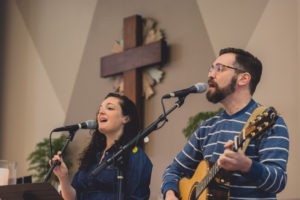 I am part of a liturgical church. Liturgy simply means “service of the people.” Paul uses it in Romans 12 to describe the spiritual “service” of offering our bodies as living sacrifices to God. Liturgical practices offer tangible means by which the generations are united in worship. One of my favorite moments of our liturgy is when my children run up to the communion rail to join me in receiving the body and blood of Christ. One Sunday my son knelt down, extended his hands to receive, and said, “Look dad, I’m making a manger.” The old woman to my left started chuckling, and I was inspired by the incarnation illustration my son had just unknowingly given us.
 Life is a bell curve of simplicity and complexity. The most unifying songs and rhythms noticeably engage the youngest and oldest among us. If we aim for the people in the middle, those whose lives are most cluttered and noisy, they may connect with the music, but it will be hard for everyone else to participate. Familiarity is the way to go with liturgical music. Familiar doesn’t mean that we need to dumb it down; it means we’re bringing it down to earth, making the music more accessible and the work of the people more doable.
 Our music, which we call Liturgical Folk, is a truly intergenerational project. You can read all about it in the Dallas Morning News article, “

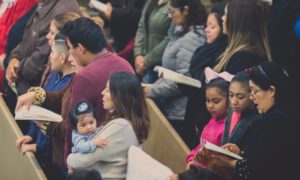 job that involves working at the school affiliated with my church. I have to say, I’d forgotten how much having children around makes each holiday feel so special. Children have an enthusiasm for celebrations and traditions that is infectious to the rest of us. Easter Sunday may not be a good time for the children’s choir to sing, but it’s perfectly appropriate to have them sing an Easter song on the Sunday(s) after Easter. Small children delight in having songs to sing that go with whatever season it is, so even if you’re working with children in a less formal setting than a choir, you can keep singing your resurrection songs all through the season. (Sidebar: I’ve found there aren’t enough Easter songs to satisfy the appetites of young children. Which Easter songs do your children love?) You might find that you have more opportunity to discuss the true meaning of Easter with the children once the Easter bunny has faded away, too.