

by Al Fedak
- Choose a text to which you feel a strong attraction.
- Read the text aloud numerous times.
- Determine the hymnic meter of the text (e.g., 8.6.8.6, LMD, etc.)
- Identify and mark the strong and weak syllables.
- Determine whether the tune should begin with an upbeat or a downbeat. When some stanzas of a particular text begin with strong syllables, and others with weak ones, try to match the opening rhythm which appears in the majority of the stanzas, and especially, whenever possible, in the first. It may sometimes be advantageous to include an opening pick-up note to be sung only on stanzas where it is needed (as in “O Come, All Ye Faithful”).
- Study each verse to determine a possible formal scheme for your tune. Where might melodic repetition occur, and where is new melodic material called for?
- Try reading the text aloud in different rhythms, to determine whether a duple, triple, or compound musical meter might fit the text best. Sometimes a combination of duple and triple meters is called for—don’t overlook the possibility of changing time signatures within the tune.
- Taking into consideration the overall tone of the text, decide whether the melody ought to be major, minor, or modal.
- If the opening words of the text naturally suggest to you a particular melodic and/or rhythmic shape, seize upon that idea, at least to get the composition process started. It may lead you in a fruitful direction.
- However, don’t become so enamored of any idea that you are unwilling to change it or even to discard it altogether. Be prepared to reject anything you have written in exchange for something better, no matter how promising an idea may have seemed at first. An important aspect of composition is the process of changing one’s mind and deciding what NOT to do.
- If the opening words of the first stanza don’t immediately suggest a strong opening melodic or rhythmic gesture, perhaps the opening words of later stanzas will, so start there instead. Or, if the hymn has a refrain, consider setting that to music first, and work your way backward.
- Strive to make the very first notes of your tune distinctive, memorable, and in most cases, upward in general direction.
- Beginning with these opening notes, try improvising a melody as you sing the text, or improvise a tune at the keyboard while reading and/or singing the words aloud.
- As much as possible, try to match textual accents with musical accents. (See #4 and #5 above.)
- Remember that aside from dynamic considerations, accents can be conveyed musically by means of pitch, rhythm (duration), and metrical placement. Notes which are higher (or lower) in pitch than their neighbors, or are held longer, draw more attention to themselves than do their surrounding notes: i.e., they are, by definition, accented. Likewise, notes on strong beats of the measure receive more emphasis than do those on weak beats. (Harmonic accents are also possible—see #31 below.)
- Consider using melismas to create emphasis on individual syllables. A melisma can also be helpful in accommodating the peculiarities of a text whose meter or rhythmic scheme varies from stanza to stanza. (As an example of this, see my hymn tune RIVERDALE.)
- Keep the melody within a manageable vocal range. C to high D is practical; an occasional low B or Bb, or high Eb (or very rarely, a high E) may be acceptable in some circumstances, as long as the tune’s overall tessitura remains comfortable.
- Try to include a good balance of stepwise and skipwise movement, both upward and downward, in the contours of your tune.
- A hymn tune is a musical miniature: every note counts. So as a general rule, one should use repeated notes sparingly, since they convey a certain lack of melodic direction.
- Identify climactic moments in the text. Ideally, the climax will be located at the same point in each stanza. If this is not the case, you may need to decide which stanza’s climax is the most important one to highlight as you fashion your melody.
- Place the highest note of the tune carefully. This should usually be located in the final third of the tune, and almost never at the end of a phrase (when singers’ breath is running out).
- Consider the effect that repetition will have upon your music. Try to lay out the form so that the tune does not become tiresome over several stanzas.
- Strive for variety at cadence points. A melody with phrases that come to rest on only one or two different pitches (for instance, scale degrees 1 & 5) may lack sufficient interest. More cadential variety generally yields a more interesting tune.
- Try to balance rhythmic repetition with rhythmic variety. Employing similar (or identical) rhythm patterns from one line to the next can produce a sense of internal coherence, but overuse of any pattern unchanged can become tedious.
- Once you have sketched out a tune, sing it over and over, using all stanzas of the text. Better yet, record the music, and sing along with your recording, as though you were a worshipper in the pew. Be on the alert for awkward or unnatural moments, and do not hesitate to change whatever needs changing.
- At some point in the process, compare your work with other, pre-existing hymn tunes having the same meter. As a composer, it is always good to see how others have dealt with issues similar to the ones you face.
- In your harmonization, strive for clarity of harmonic direction.
- Work for a strong and interesting bass line. The best bass lines create good two-part counterpoint with the tune, and clearly define the harmonies, even without the help of the inner voices.
- A stepwise or “walking” bass line can be a very helpful device. It can often be used to justify your choices of harmony, and gives an impression of forward movement to the music.
- Vary the texture and spacing of the chords in your harmonization, both for the purposes of color, and to create interest in the lines of the individual voice parts. Do this even if the hymn is to be sung in unison with instrumental accompaniment: an interesting accompaniment is always desirable, whether sung, or played on organ, piano, guitar, or whatever.
- Don’t overlook the emotional implications of harmony. Once all the basic functional aspects of your harmonization have been fulfilled, try substituting a more colorful harmony here and there to highlight or emphasize particular words or phrases. The simplest chord substitutions involve the use of secondary harmonies for primary chords, minor chords for major, and vice versa.
- If you get stuck, and are having difficulty harmonizing a particular note or passage, remember that any note in a melody may be either harmonic or non-harmonic. If harmonic, it may be the root, third, or fifth (or occasionally the seventh) of a major or minor triad (or, less often, of a diminished or augmented triad). If non-harmonic, the note in question may be treated as an upper or lower neighbor, a passing tone, a suspension, an appoggiatura, or an escape tone, depending on its context (i.e., what happens immediately before and after the note, both melodically and harmonically). Don’t be intimidated by all of this: experiment with the various possibilities.
- Remember that first-inversion harmonies often substitute well for root-position chords. They can yield smoother bass lines and result in a subtler, more polished effect.
- Avoid functionless second-inversion triads at all costs! In traditional usage, second-inversion harmonies are only permissible (1) as cadential six-four chords, (2) as passing six-fours, and (3) as the result of bass arpeggiation or a pedal point.
- Maintain a consistent musical style in your harmonization. If your tune employs traditional harmonic language, follow the rules of good counterpoint and voice leading throughout. (In other words, resolve cadences properly, and avoid voice-leading errors such as doubled leading tones, parallel octaves and fifths, and melodic augmented seconds.) On the other hand, if your music is in a less conventional style, establish that style clearly at the outset, so that singers will have a better sense of what is to follow.
- Occasionally, as you work out your harmonization, the harmonies you select may suggest changes to the melody you have already written. Allow them to do so, if the overall effect is beneficial.
- Consider at all times the effect that your harmonization will have upon singing worshippers. The best and most helpful harmonizations are those which draw singers naturally and inevitably from one note of the melody to the next, even at first hearing.
- Once you have crafted a tune and a harmonization with which you are satisfied, put the music away and avoid thinking about it. After a few days, take it out and sing through it as though you were seeing it for the first time. If any part of the tune strikes you as awkward, difficult, or (worst of all!) dull, do not hesitate to discard any or all of it immediately and head back to the drawing board. Be ruthlessly self-critical.
- Next, allow more time to pass. If the tune still pleases you, show it to a friend or colleague (preferably one who is at least musical enough to sing hymns in church). Ask him or her to sing it and/or play it, and consider carefully what he or she may suggest.
- Finally, at all times, keep in mind that hymn tunes are written for performance by, for the most part, unrehearsed non-musicians, at primarily non-musical events (i.e., church services). For this reason, the ideal hymn tune must be both fresh and foolproof, substantial, yet singable. This is a delicate balance, but one which, when achieved, yields the greatest rewards.
(c) Alfred V. Fedak www.alfredfedak.com
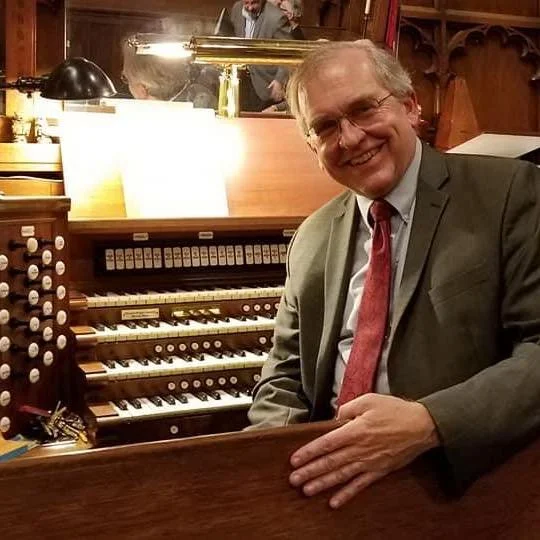
A widely-published and well-known composer of church music, Mr. Fedak has well over 300 choral and organ works in print, and more than 100 of his hymn tunes, as well as his many arrangements, appear in hymnals and collections throughout the English-speaking world and Asia. Mr. Fedak has earned many awards in organ performance and composition, including the AGO’s prestigious S. Lewis Elmer Award, as well as grants and prizes from the New York State Council on the Arts, the Music Teachers’ National Association, the Hymn Society, the Kalamazoo Bach Festival, and the John Ness Beck Foundation, and has received ASCAP Plus awards annually since 2001. He also continues to manage a busy schedule of freelance performing, teaching, and composition. Al and Susan are the parents of two grown sons: Peter and Benjamin. They have two grandchildren.